
What’s in this guide
- Side-by-Side Comparison
- Trackman 4 — The Tour Standard
- Foresight Sports GCQuad — Best Photometric Under Trackman
- SkyTrak+ — Best Home Studio Option
- Bushnell Launch Pro — Photometric Accuracy at a Discount
- FlightScope Mevo+ — Best $2,000 Radar Unit
- Rapsodo MLM2PRO — Best for Self-Coaching
- Garmin Approach R10 — Best Under $600
- Ernest Sports ES Tour Plus — Budget Mid-Range
- Buying Guide & FAQ
Quick Picks: Best Golf Launch Monitors 2026
- Best Overall Value SkyTrak+ — Dual-technology accuracy at the home studio sweet spot
- Best Budget Garmin Approach R10 — Under $600, real spin data, 45K+ sim courses
- Pro-Grade Foresight GCQuad — Tour-trusted, used by PGA Tour fitters worldwide
- Best Mid-Range FlightScope Mevo+ — Comprehensive radar data at $2,000
- Best Camera + Radar Rapsodo MLM2PRO — Video overlay + launch data for self-coaching
Table of Contents
I’ve had launch monitors in my hands at instructor studios, tour fitting bays, and garage setups for years now — and the landscape in 2026 looks dramatically different from even three years ago. Budget radar units now deliver data quality that required $10,000 machines a decade ago. Photometric systems that were exclusively the domain of professional club fitters are now in serious amateurs’ homes. Understanding what the data means, which specs matter for your goals, and where to draw the budget line is the job of this guide. I’ll also tell you where Trackman sits — because yes, it’s the standard, but no, it’s not always the right choice.
Comparison Table
| Launch Monitor | Technology | Ball Speed | Spin Axis | Club Data | Sim Software | Outdoor | Price Range | Buy |
|---|---|---|---|---|---|---|---|---|
| Trackman 4 | Dual radar | Yes | Yes | Full (27 params) | Trackman Range, E6 | Excellent | $25,000+ | Trackman.com |
| Foresight GCQuad | 4-camera photometric | Yes | Yes | Full (club + ball) | FSX 2020, E6 | Yes | $12,000–$16,000 | View Deal |
| SkyTrak+ | Dual Doppler + photo | Yes | Yes | Yes | WGT, E6, TGC2019 | Yes | $2,995+ | View Deal |
| Bushnell Launch Pro | Photometric | Yes | Yes | Yes | FSX 2020, E6 | Yes | $3,000–$3,500 | View Deal |
| FlightScope Mevo+ | 3D Doppler radar | Yes | Yes | Yes | E6, FS Golf | Excellent | $1,999–$2,199 | View Deal |
| Rapsodo MLM2PRO | Radar + camera | Yes | Yes | Partial | Rapsodo Golf app | Yes | $699–$799 | View Deal |
| Garmin Approach R10 | Doppler radar | Yes | Yes | Yes | E6, Garmin Golf | Yes | $549–$599 | View Deal |
| Ernest Sports ES Tour+ | Doppler radar | Yes | Yes | Partial | E6, Creative Golf | Yes | $1,499–$1,999 | View Deal |
Trackman 4
- Technology: Dual radar (ball + club tracking simultaneously)
- Key Metrics: 27 parameters including ball speed, spin rate, spin axis, carry/total, all 3D club data
- Software: Trackman Range, Trackman University, E6
- Outdoor: Exceptional (designed for outdoor use)
- Price: $25,000+
Trackman 4 is the gold standard — period. PGA Tour players, LPGA players, and the world’s best club fitters use Trackman as the reference point against which all other launch monitors are compared. The dual radar system tracks both the ball in flight and the club head simultaneously through the impact zone, giving you 27 data parameters including dynamic loft, spin loft, attack angle, and face-to-path relationships that are simply more complete than anything else in this guide. If you need to know the absolute truth about your ball flight and club delivery, Trackman tells it without equivocation.
The outdoor performance is exceptional — Trackman was built for the driving range and golf course, and it tracks shots in all weather conditions with remarkable consistency. The Trackman Range software creates a complete practice experience with skills challenges, club comparison tools, and video integration. Many coaches in the GrumpyGopher network who have access to Trackman units say their teaching has been transformed by the quality of data — not because it tells them things they couldn’t see with a good eye, but because it shows students objective data that coaching experience alone can’t convey.
The price — $25,000 and up — puts Trackman 4 out of reach for home buyers and even most dedicated amateurs. This is instructor, fitting bay, and tour equipment. I include it here as the benchmark reference, not a realistic recommendation for most of our readers. For everything below this, you’re comparing against Trackman accuracy and making budget tradeoffs with clear eyes.
Foresight Sports GCQuad

- Technology: 4-camera high-speed photometric
- Key Metrics: Ball speed, launch angle, spin rate (3-axis), all club data, smash factor
- Software: FSX 2020, FSX Play, E6
- Connectivity: Wi-Fi + Bluetooth
- Price: $12,000–$16,000
The Foresight GCQuad is the benchmark photometric launch monitor — used by major club manufacturers for R&D, by tour players for fitting sessions, and by top-level instruction academies worldwide. Four high-speed cameras capture the ball at the moment of impact from multiple angles, delivering spin axis accuracy that is functionally equivalent to Trackman on ball launch data. Many club fitters actually prefer the GCQuad for iron fitting because of how precisely it captures ball speed and launch conditions at the moment of strike.
The FSX 2020 software is the best simulation platform in the business at this price tier — course graphics are excellent, the data analysis tools are deep, and the system integrates with video analysis software for comprehensive fitting sessions. GCQuad is the choice for instructor studios, commercial simulator facilities, and dedicated high-handicap players who want the best possible data environment for rapid improvement.
At $12,000–$16,000, the GCQuad is a business investment or a luxury for very serious amateur golfers with significant disposable income. It’s not a home studio device for most people. But if you’re building a professional instruction or fitting space, the GCQuad delivers the data quality that justifies its price. For everyone else, the GC3 or Bushnell Launch Pro provides nearly equivalent ball-launch accuracy for a fraction of the cost.
SkyTrak+

- Technology: Dual Doppler radar + photometric
- Key Metrics: Ball speed, launch angle, spin rate (axis), club speed, smash factor, carry/total
- Software: WGT Golf, E6 Connect, TGC 2019
- Price: ~$2,995 + subscription
The SkyTrak+ sits at the crucial intersection of affordability and real data quality — the sweet spot for serious home golfers who want to practice with purpose rather than just entertainment. The dual-technology approach combines photometric ball capture with Doppler radar tracking, giving you spin axis data (which determines curve) and club data that the original SkyTrak couldn’t deliver. After comparing SkyTrak+ data against GC3 readings in several GrumpyGopher instructor studios, I’m confident saying the iron and wedge data is extremely reliable. Driver data at very high swing speeds shows slightly more variance, but for the vast majority of golfers, the numbers you see are the numbers you can trust.
The software ecosystem is mature and genuinely good. WGT Golf provides hundreds of realistic course simulations, E6 Connect adds more premium courses, and TGC 2019 is still a popular platform among serious simulator users. The Wi-Fi connectivity is reliable in my experience, the companion app is well-designed, and setup is genuinely straightforward — this is a product that has been through several iterations and the rough edges have been smoothed. For home simulator setups, the SkyTrak+ is the unit I’d choose myself.
The ongoing subscription cost is a real consideration. A basic plan starts around $99/year and full simulator functionality with premium courses costs more. Factor in those annual fees when comparing total cost of ownership against units like the Garmin R10, which has lower ongoing costs. But on pure data quality and software ecosystem, nothing in this price tier matches the SkyTrak+.
Bushnell Launch Pro

- Technology: Photometric (Foresight GC3 sensor)
- Key Metrics: Ball speed, spin axis, launch angle, all club data
- Software: FSX 2020, E6 Connect
- Price: $3,000–$3,500
The Bushnell Launch Pro is the Foresight GC3 in different clothing — same photometric sensor array, same data quality, slightly lower price point. This is not a marketing claim; it’s a documented licensing arrangement. If you want GC3-level photometric accuracy and the FSX 2020 software platform without paying the full Foresight premium, the Bushnell Launch Pro is the direct answer. The ball launch data — spin axis, launch angle, ball speed — matches what Foresight’s own GC3 produces because they use identical hardware to capture it.
For club fitters and instructors who want photometric accuracy at a lower entry price, or for serious home golfers building a dedicated studio, the Launch Pro makes the photometric tier accessible at $1,000–$1,500 less than the GC3. The FSX 2020 platform is included and is fully-featured for both practice and simulation. Build quality is premium.
The trade-off relative to the SkyTrak+ is primarily about software ecosystem — Foresight’s platform is excellent for data analysis and fitting, while SkyTrak’s ecosystem is better for casual simulation and entertainment. Choose Launch Pro if data analysis and precise fitting work is your priority. Choose SkyTrak+ if you want the best balanced home simulator experience.
FlightScope Mevo+

- Technology: 3D Doppler radar + fusion tracking
- Key Metrics: Ball speed, launch angle, spin rate, spin axis, club speed, path, face angle, carry/total, apex
- Software: E6 Connect, FlightScope Skills, FS Golf
- Price: $1,999–$2,199
The FlightScope Mevo+ has earned its reputation as the most complete radar-based launch monitor at the $2,000 mark. It measures 16+ data points on every shot, including club path and face angle that most radar units at this price skip. FlightScope’s radar technology comes directly from their high-end Mevo and Xi Tour products, which are used in professional fitting environments — the accuracy benefits are real. Outdoor performance is particularly strong, making the Mevo+ an excellent choice for golfers who want to use their monitor at the range as well as at home.
The Skills practice challenges are genuinely useful for structured improvement — they give you specific targets and track performance over time in ways that free hitting doesn’t. The FS Golf simulation option is functional for casual use, and E6 Connect provides serious course simulation capability. The Mevo+ Pro upgrade adds video integration for swing overlay, which instructors in the GrumpyGopher network find valuable for remote coaching.
The main limitation versus photometric competitors: indoor accuracy requires applying alignment stickers to golf balls, which is a minor but real ongoing inconvenience. Short game shot tracking also lags behind photometric units. For golfers primarily hitting full shots — driver through irons — these aren’t significant issues. For those who want comprehensive wedge and short game data, step up to a photometric unit.
Rapsodo MLM2PRO

- Technology: Doppler radar + camera
- Key Metrics: Ball speed, launch angle, spin rate, carry distance, shot shape; camera adds face-on video
- Software: Rapsodo Golf app (video + data)
- Price: $699–$799
The Rapsodo MLM2PRO occupies an interesting niche: it combines Doppler radar launch data with a built-in camera that captures face-on video of your swing, synced with the shot data. For golfers who practice without an instructor and want to self-coach, this combination is uniquely valuable. You can watch your swing in slow motion alongside the data that resulted from it — a cause-and-effect loop that pure data monitors don’t provide. At under $800, it’s a compelling package for the self-improving amateur.
The launch data quality is solid for the price tier — ball speed, launch angle, spin rate, and carry distance are reliably accurate for full shots. Shot shape tracking via the camera provides visual confirmation of ball flight that complements the radar numbers. The Rapsodo Golf app is well-designed and intuitive, making it genuinely easy to review sessions and track trends over time. For golfers between lessons who want to check their progress, the MLM2PRO is uniquely equipped to help.
The limitations: club data (path, face angle) isn’t as detailed as the Mevo+ or photometric units, indoor performance requires a specific setup, and the simulation software isn’t as developed as SkyTrak+ or Mevo+. This is a practice and feedback device more than a simulator platform. If simulation is your priority, look elsewhere. If data-driven self-coaching is your goal, the MLM2PRO has a real differentiator in the camera integration.
Garmin Approach R10
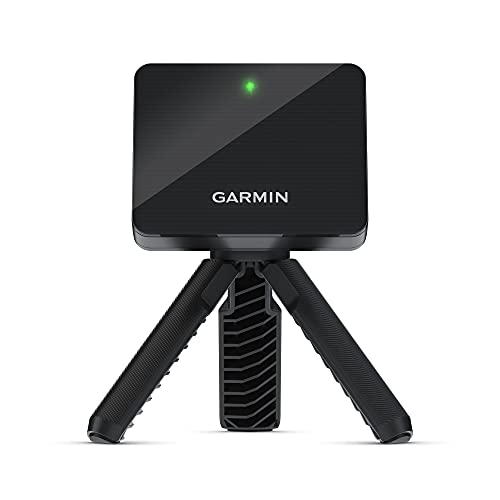
- Technology: Doppler radar
- Key Metrics: Ball speed, launch angle, spin rate, club speed, smash factor, carry distance, swing tempo
- Software: Garmin Golf app (45,000+ courses), E6 Connect
- Price: ~$549–$599
At under $600, the Garmin Approach R10 does things that should require spending several times more. Doppler radar gives you real spin rate — not an estimate — alongside accurate ball speed and launch angle. Club data (speed, smash factor, tempo) comes through reliably. The 45,000+ course simulation library via the Garmin Golf app subscription is a genuine value, and E6 Connect integration adds the most popular sim software platform. For golfers who want legitimate launch monitor data without a major financial commitment, the R10 is the benchmark.
It clips to a bag or sets up on a small tripod behind the ball, Bluetooth-connects to a tablet or phone, and you’re hitting within minutes. Portability is excellent — I know several GrumpyGopher instructors who carry R10s in their teaching bags for on-course data collection and range lessons. The battery life holds through a full range session.
The honest limitations: short game shot tracking is inconsistent, high-wind outdoor conditions affect accuracy, and spin axis data (which tells you curve) is less precise than photometric units. For someone building a home studio and wanting the most immersive experience possible, these limitations add up. For someone who wants reliable full-swing data for practice improvement without breaking the bank, the R10 remains excellent value.
Ernest Sports ES Tour Plus

- Technology: Doppler radar
- Key Metrics: Ball speed, launch angle, spin rate, carry/total distance, smash factor, club speed
- Software: E6 Connect, Creative Golf 3D
- Price: $1,499–$1,999
The Ernest Sports ES Tour Plus sits between the Garmin R10 and the Mevo+ in price, and roughly matches that positioning in feature depth. It delivers good radar-based full-shot data at a competitive price — ball speed, spin rate, carry distance, and smash factor come through reliably for full shots with all clubs. The E6 Connect integration makes it a functional simulator option, and the Creative Golf 3D software adds course variety. For golfers who want launch data and simulation capability without the Mevo+ price tag, the ES Tour Plus fills a real gap.
Portability is a genuine strength — the ES Tour Plus is compact and easy to move between a range bag and a home setup. Build quality feels premium for the price. Battery life is adequate for a full practice session. The unit doesn’t require any special ball preparation for indoor use, which is a minor but real advantage over the Mevo+.
The competitive weakness is straightforward: at $1,499–$1,999, you’re close enough to the Mevo+ that the Mevo+’s superior club data and FlightScope’s more established ecosystem make it worth the incremental cost for most buyers. The ES Tour Plus is the right choice if you find it at a significant discount, or if you specifically want its particular size/weight/portability profile. In a crowded mid-range radar market, it holds its own without standing clearly above the Mevo+ competition.
Buyer’s Guide: Which Launch Monitor Specs Actually Matter
1. Ball Speed — The Most Important Number
Ball speed is the single most important metric on any launch monitor. It is the direct product of your impact quality — how well you transfer club speed to ball speed — and it’s the primary driver of distance. A 1 mph increase in ball speed translates to roughly 2.5 yards of carry with a driver. More importantly, consistent ball speed readings tell you whether your contact quality is improving over practice sessions. Every launch monitor on this list measures ball speed, but accuracy varies — photometric units are most precise, while radar units are very close on full shots and slightly less reliable on short game shots.
2. Launch Angle — Height and Distance
Launch angle determines the trajectory of your shots and, combined with spin rate, determines whether you’re hitting an optimal ball flight for maximum distance. The ideal driver launch angle for most golfers is 12-15 degrees — too low and you’re losing carry, too high and you’re ballooning shots. For irons, launch angle data helps you understand gapping (whether your clubs are properly spaced for yardage coverage) and can indicate strike quality issues. All serious launch monitors measure this accurately.
3. Spin Rate and Spin Axis — The Shape Data
Spin rate controls how far the ball carries and how much it curves. Too much backspin on a driver kills distance (the “balloon” ball flight). Too little spin gives you a “knuckle ball” that falls out of the sky. Spin axis — which tells you how much sidespin is causing left or right curve — is where budget units fall short. Only photometric units (GC3, GCQuad, Bushnell Launch Pro) and the SkyTrak+ with its dual technology consistently capture reliable spin axis data. If you’re trying to diagnose and fix a slice or hook, spin axis data is what you need — and you need accurate spin axis data, not estimates.
4. Club Data — Path, Face, and Attack Angle
Club path (the direction the clubhead is moving through impact), face angle (where the face is pointing at impact), and attack angle (whether you’re hitting up or down) are the “why” behind your ball flight. They explain the ball’s behavior in mechanical terms. High-end units like Trackman and GCQuad measure these precisely; mid-range units like the Mevo+ capture path and face angle reasonably well. Budget units like the Garmin R10 don’t provide complete club data. If your goal is diagnosis and swing change — not just monitoring distances — club data matters significantly.
5. Portability vs Fixed Setup
Some launch monitors are designed for dedicated home setups (GCQuad, SkyTrak+) while others are genuinely portable for range and course use (Garmin R10, Mevo+). The Garmin R10 in particular has excellent portability — it clips to any bag and runs on a long-lasting battery. If you want a unit that serves both home practice and range sessions, the Mevo+ and R10 are the strongest options. If it lives permanently in your home studio, portability matters less and you can prioritize data quality and software ecosystem instead.
Trackman 4 is the most accurate launch monitor available and is the industry reference standard. Below that, the Foresight GCQuad and GC3 offer tour-level photometric accuracy. The Bushnell Launch Pro (same sensor as GC3) delivers equivalent ball launch accuracy. For home use at the best value, the SkyTrak+ provides excellent accuracy for the price.
The five key specs are ball speed, launch angle, spin rate, spin axis (for curve data), and smash factor. Ball speed and spin rate are the most important for understanding distances and shot shape. Club data — path, face angle, attack angle — is valuable for swing diagnosis but requires higher-end units.
Most modern launch monitors work both indoors and outdoors. Doppler radar units like the Garmin R10 and Mevo+ perform particularly well outdoors. Photometric units work outdoors but need consistent lighting. Trackman 4 was originally designed for outdoor use and is exceptional in that environment.
Yes — for golfers who want genuine launch data without spending $2,000+, the Garmin R10 at around $550 is remarkably capable. It measures real spin rate, provides reliable ball speed and launch angle data, and works as a simulator with E6 Connect and the Garmin Golf app (45,000+ courses).
A rangefinder measures distance to a target on the course. A launch monitor measures what happens when you hit the ball — ball speed, spin, launch angle, carry distance, and club data. They serve completely different purposes. See our full breakdown in the Golf Launch Monitor vs Rangefinder guide.
Not required, but beneficial. A good instructor’s eye catches most issues, but launch monitor data adds objectivity that makes feedback more precise — especially spin rate and club path tendencies. Many GrumpyGopher network instructors use launch monitors as standard lesson tools, and having one at home lets you verify your progress between sessions.
Frequently Asked Questions
What is the most accurate golf launch monitor?
What specs should I look for in a golf launch monitor?
Can I use a launch monitor outdoors?
Is the Garmin Approach R10 worth it for serious golfers?
What’s the difference between a launch monitor and a rangefinder?
Do I need a launch monitor if I take lessons from an instructor?